Best Voltage for THC Carts: What It Is & What You Need to Know
The best voltage to maximize flavor and potency is most of the time the lowest possible. Sometimes you only need a tiny bit to get the most, and this applies to voltage for THC carts, too. There’s no definitive number, as other factors are at play, including the viscosity of the concentrate in your cart’s tank, the settings, and the battery (power), among others. In this blog, we’ll let you in on what you need to know about matching voltages with your stash and the sessions you want to achieve.
Key Takeaways
- The best voltage for THC carts is usually at the low end of your battery’s range, where flavor and potency stay balanced without stressing the coil.
- Different oil types—live resin, rosin, full-spectrum, and distillate—each perform best at specific voltage ranges. This is mainly due to their viscosity and terpene content.
- Small voltage changes of just 0.1–0.2 V can be enough. They can shift a session from thin or muted hits to dense, smooth vapor with strain authenticity.
- Clear warning signs include thin vapor, delayed activation, a harsh throat hit, burnt or peppery notes, and rapid oil darkening. These usually indicate that the voltage is set too low or too high.
- Voltage, wattage, coil resistance, and battery type all influence cart performance. They also affect flavor clarity and the cartridge's lifespan with repeated use.
What Is the Best Voltage for a THC Cart and How to Choose It
There is no single universal best voltage for cannabis vape carts. Different factors should be considered when choosing the best voltage, including oil viscosity, terpene composition, coil resistance, and airflow change. For newbies, they can do a straightforward test: start with low and short puffs at the lowest voltage possible. Then, consider 0.1 or 0.2 increments to add to achieve the best balance of potency and strain-authentic flavor.
Ideal Voltage Range for Smooth and Clean Hits
The best operating voltage range for producing smooth and clean hits exists between 2.2–2.4 V for terpene-rich oils and 2.6–2.8 V for distillate products. Begin with 2–3 second puffs at 2.2–2.4 V for terpene-rich oils and 2.6–2.8 V for distillate while maintaining 60–120 seconds between draws. The voltage should increase by 0.1–0.2 V until you reach the peak flavor point and achieve a comfortable vapor density in the vapor. Stop using the device before you experience harshness or hear a popping sound.
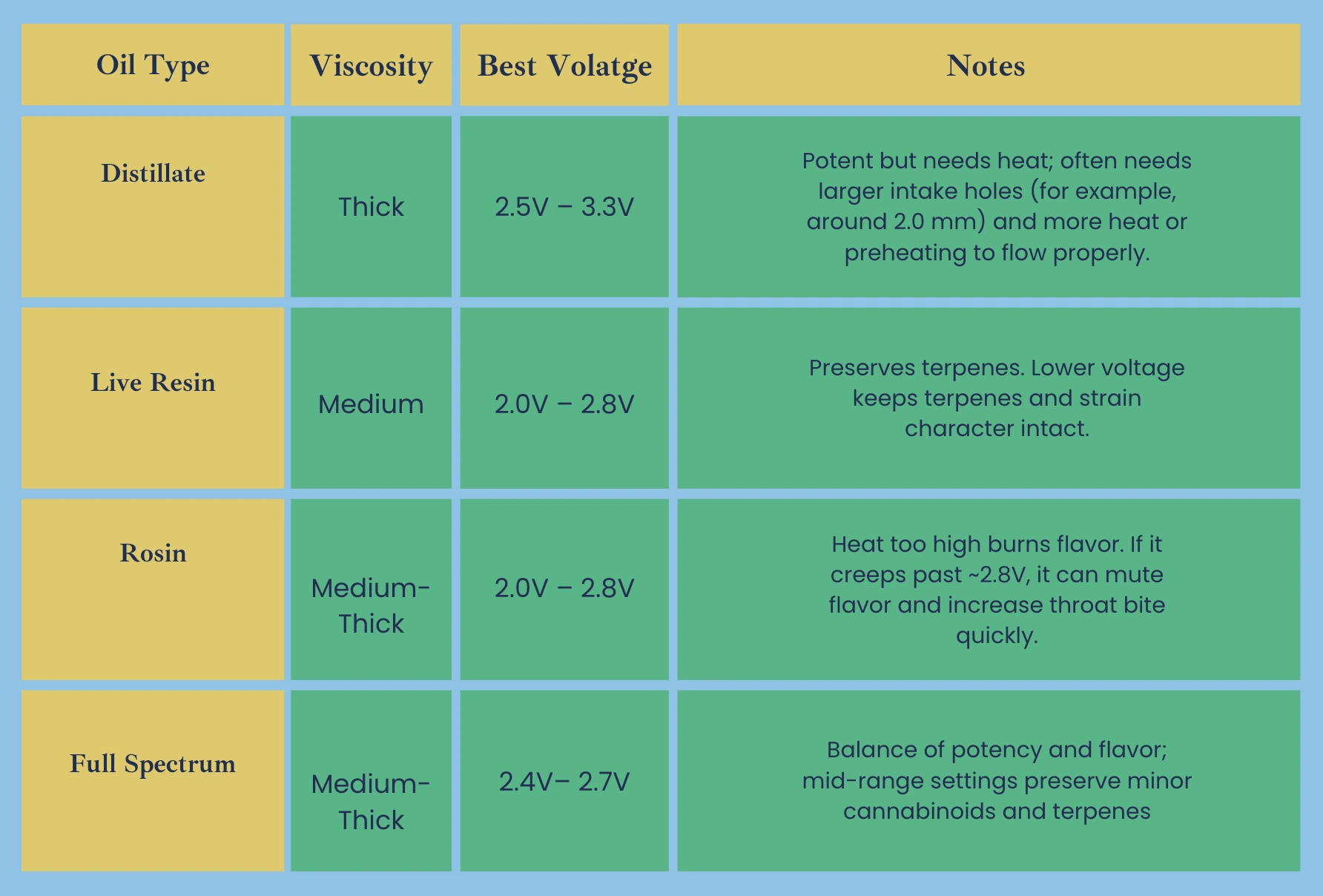
Best Voltage Settings for Different Oil Types
A lower voltage is needed for live resin or rosin for maximum terpene retention. For distillates, slightly higher settings allow for dense clouds.
Variable Voltage vs Auto-Draw Batteries
How to Adjust Voltage for Flavor or Potency
It depends on how you want your experience to go. You can either prioritize the potency or the flavor when adjusting voltage.
Flavor-first, potency-second:
- Start with the lowest band for oil type.
- Pull 2–3 second puffs.
- Rest 60–120 seconds.
- Raise the voltage to 0.1–0.2 V until the flavor peaks
- If peppery/burnt notes or popping occur, stop.
Potency-first, flavor-second:
- Start mid-band.
- Pull the shortest puff length that satisfies.
- Only step up if the vapor is too thin
- Avoid exceeding the ceiling to limit thermal risks.
- High Voltage (3.3V+) is great for the densest concentrates. Note that high voltage also risks terpene degradation and harshness.
- Low Voltage (2.0V – 2.6V) is best for live resin/rosin and delicate terpene profiles. Also, easier to achieve smooth pulls (for the throat), and more elaborate flavor structure.
- Medium Voltage (2.7V – 3.2V) gives a good balance for distillate and some full-spectrum oils. This can easily go wrong (as you start at the mid band), so watch out for the first signs of harshness.
- High Voltage (3.3V+) is great for the densest concentrates. Note that high voltage also risks terpene degradation and harshness.
How Voltage Affects THC Cart Performance
Voltage pushes power through a coil because of its resistance. If you use a higher voltage, the coil heats up more quickly, which can cause it to become very hot during use. Using a lower voltage may also cause the device to malfunction.
What Happens When Voltage Is Too Low
When the voltage is low, not much happens, or the device might not work well. You’ll know it’s too low when you notice the following:
- Light, wispy vapor and subdued flavor due to cannabinoids and terpenes not being fully vaporized thin vapor.
- Muted flavor.
- Delayed activation on thicker concentrates, since viscous oil struggles to wick and heat.delayed activation (on thick concentrates).
- Seepage or leaking can happen when the oil doesn't heat up enough. Instead of turning to vapor, it collects around the intake holes prospective water leak.
What Happens When Voltage Is Too High
When the voltage is too high, there will be signs of overheating or burning. This includes:
- Irregular flavor.
- Oil darkens due to oxidation and heat stress near the coil.
- Popping or sputtering happens when a hot wick heats the oil too much. This causes trapped bubbles to expand quickly and burst.popping/sputtering from overheating.
How to Keep Flavor Clear
Take small puffs for a few seconds at a time. Rest between each puff. Keep the device’s voltage safe for the oil. Choose high-resistance, well-wicked ceramic cartridges instead of moderate heat. If it feels harsh, turn down the power.
Understanding Voltage, Wattage, and Battery Type
What Voltage Means in a Vape Battery
Voltage and resistance work together to determine the power (wattage) the coil consumes. But, factors like your puffing style and coil construction also influence the coil’s temperature. Effective temperature control helps maintain consistent coil performance. Voltage control offers a subtle way to adjust power, subsequently affecting the coil’s temperature.
The Difference Between Voltage, Wattage, and Temperature
Voltage is essentially the battery’s “push,” driving the electricity. Wattage represents the power delivered – the energy being used. Coil resistance restricts the electrical flow, impacting the coil’s temperature. A lower resistance coil with a constant voltage will heat up more because it uses more power.

Types of Vape Batteries and Their Voltage Control Options
Variable Voltage vs Auto-Draw Batteries
Variable-voltage batteries and auto-draw batteries differ mainly in how they power the cartridge.
Variable Voltage
- Known for fine-tuning capabilities that allow a user to achieve the most precise heat level for full flavor and dense and smooth clouds
- Voltage directly controls the electrical pressure, which controls the coil's temperature
- Pros: power customization and preheat or temp control features
- Cons: might be complex for beginners
Auto-draw Voltage
- The cart automatically activates when the user inhales (through the mouthpiece); no buttons
- Internal airflow sensors detect the draw, signaling the chip inside to apply power
- Pros: ideal for beginners; compact and lightweight
- Cons: airflow sensors might require firmer pull or might encounter accidental triggers
Consumers seeking simple vaping often choose auto-draw batteries for their first experience. Consumers who want to customize their vaping will choose variable-voltage batteries. They can adjust flavor, cloud production, and oil thickness. Start with the lowest setting, no matter the battery type. Then, slowly increase it. This helps avoid burnt hits and extends cartridge life.
What Voltage Should I Use for My THC Cart?
The voltage depends on what type of concentrate is in your cart. Live resin/rosin is usually more viscous. Meanwhile, full-spectrum is less volatile, but it retains many of the same compounds. Distillate is thin because it undergoes a highly refined process.
Live resin: start 2.0–2.4 V, step up by 0.4V only if needed.
- Full-spectrum: start 2.4–2.6 V, cap ~2.9 V.
- Distillate: start 2.6–2.8 V (typically 2.8–3.2 V).
Best Practices for Safe and Consistent Voltage Use
How to Test New Carts Safely
Cannabis Consumers should visually inspect their cartridge before its first use. Consumers should verify their cartridge has no broken glass and no signs of leakage or bent connectors. Consumers should check the oil for any unusual smells, which could indicate contamination. The cartridge must match your battery through its 510-thread connection for correct operation.
- For batteries with preheat mode, use it for about 2-3 seconds at low voltage to warm the oil and saturate the wick.
- Use the voltage range from above (depending on the concentrate you got) to ensure safe, low-start puffing. This avoids harshness in your throat and overheating your cart.
- When vapor is a bit muted (as observed), you need to raise the voltage a bit (by 0.1 to 0.2 V) to hit the ideal balance for flavor and vapor.
Proper Charging and Power Handling
Consumers should charge their devices through the recommended chargers and cables that manufacturers provide for their batteries and vape pens. Consumers can follow these additional steps for their devices.
- Don’t overcharge. The built-in overcharge protection of modern carts protects devices, but extended battery charging times reduce battery lifespan.
- The charger output voltage needs to match the cart input voltage for proper device operation. The device will maintain its full operational capacity when you use the correct voltage setting.
- Always recheck voltage settings. When fully charged, batteries reach their full voltage. However, as they discharge, the voltage can drop slightly.

Using the Right Battery for Each Cartridge
To get the thickest vapor clouds and richest flavors, ensure battery compatibility. Mismatch can easily cause poor conductivity, leading to underperformance or damage to the device.
- Ensure that the battery and cartridge share the same connector standard, as most oil carts use a 510 thread. Additionally, confirm that the center pin makes solid electrical contact.
- Check the battery’s output range against the cart’s recommended voltage band. Usually, high-terpene or live resin carts prefer lower settings. In contrast, thicker distillate blends often require the mid- to upper-end of the range.
- Many preset batteries color-code their modes, such as low, medium, and high. These presets are calibrated for typical coil resistances and oil viscosities. When testing a new cartridge, use the lowest setting first. Only increase the power if the vapor is too thin.
- Each cartridge design features a specific coil resistance and intake size. So, using a compatible battery that provides the correct voltage or wattage keeps the coil temperature in the best range.Verify battery and cartridge have matching 510 threads.
- Batteries with presets (which often come in different colors) are tailored for different oil types.
- Every cart has a corresponding coil resistance measurement, so the battery must match it too.
Getting the Best Flavor from Your THC Cart
How Voltage Affects Flavor Profiles
Lower voltages preserve volatile terpenes. Aim for the lowest voltage that delivers satisfying vapor. Use short puffs and rests to limit coil heat rise.
- For optimal flavor, start on the lowest setting for your oil type and take puffs lasting 2–3 seconds each.
- If the vapor feels too thin, gradually increase the voltage in small steps and halt immediately when the taste becomes sharp or peppery.
Finding the Perfect Voltage for Potency and Smoothness
THC turns into vapor easily when the wick is full. Longer or hotter pulls can make it harsher rather than more effective. So, aim to find the sweet spot just before it gets harsh for the best experience.
- Determine the number of puffs required to feel effects at a moderate voltage and use this as your "baseline dose.”
- If hits are harsh or cause coughing immediately, lower the voltage by one step and shorten the puff.
Should You Change Voltage During a Session?
Yes, Minor downshifts keep flavor as the cart warms. Minor upshifts help cold or thick oil start flowing. Start with a lower voltage for the first few puffs. Then, make small increases as the coil and oil warm. Step back down if the flavor turns dull or peppery.
- If the cart is cold or the oil looks thick, start at the next step for the first 1–2 puffs. Then return to your usual setting.
- If the flavor weakens during your session, lower the voltage a bit. Let the cart rest for a moment. This helps the wick re-saturate before your next draw.
Ready for smoother sessions and full flavor from your next cart? Check out the full lineup of Jive cannabis cartridges and find the perfect fit for your daily routine. Retailers interested in carrying Jive carts can contact ICH Industries for wholesale inquiries.
Frequently Asked Questions
What is the best starting voltage for a new THC cart?
For live resin or rosin, set the voltage to 2.0–2.4 V. For full-spectrum, use 2.4–2.6 V. For distillate, aim for 2.6–2.8 V. Take small puffs. Rest in between. If needed, raise the voltage by 0.1–0.2 V.
What voltage should I use for live resin or rosin carts?
2.0–2.8 V. Only increase by 0.1 or 0.2 when you feel the vapor is too thin.
Can voltage settings affect how long my cart lasts?
Yes.—Running hotter degrades terpenes faster and can darken oil.
What voltage should I use in cold weather?
A cart with a preheat will work seamlessly. But if you need to do it manually, preheat with a voltage at the lowest band.